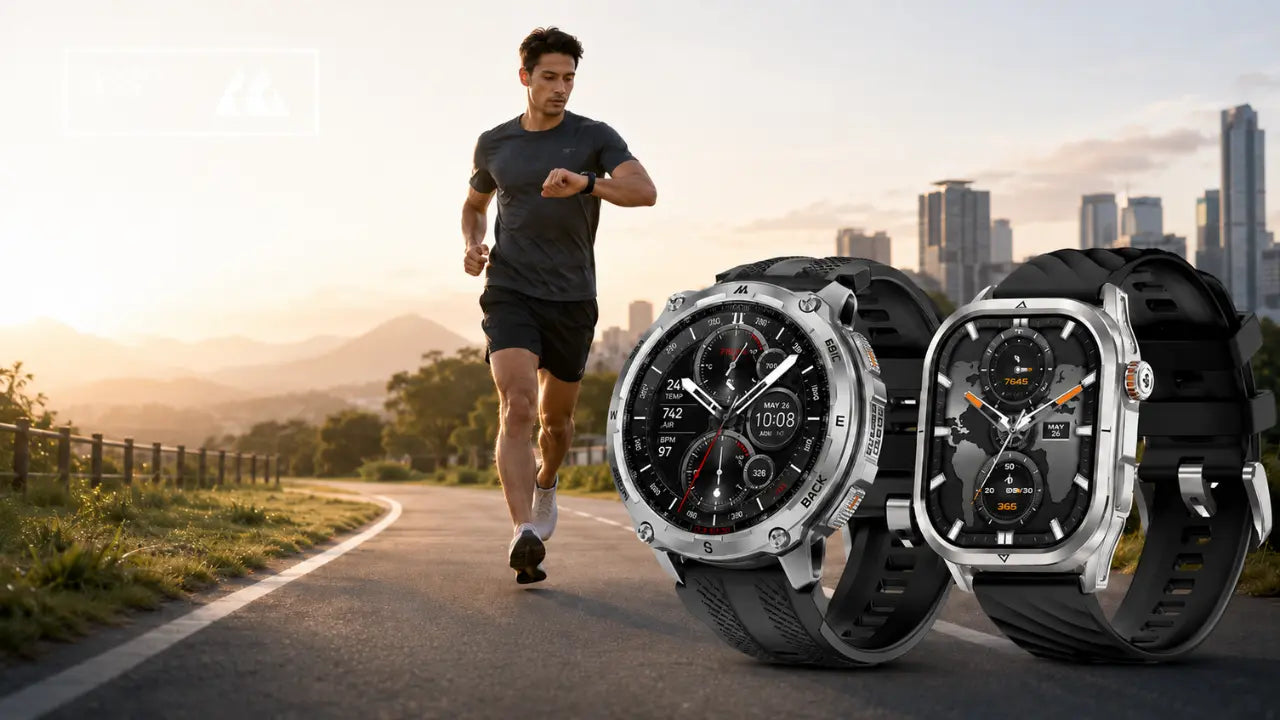

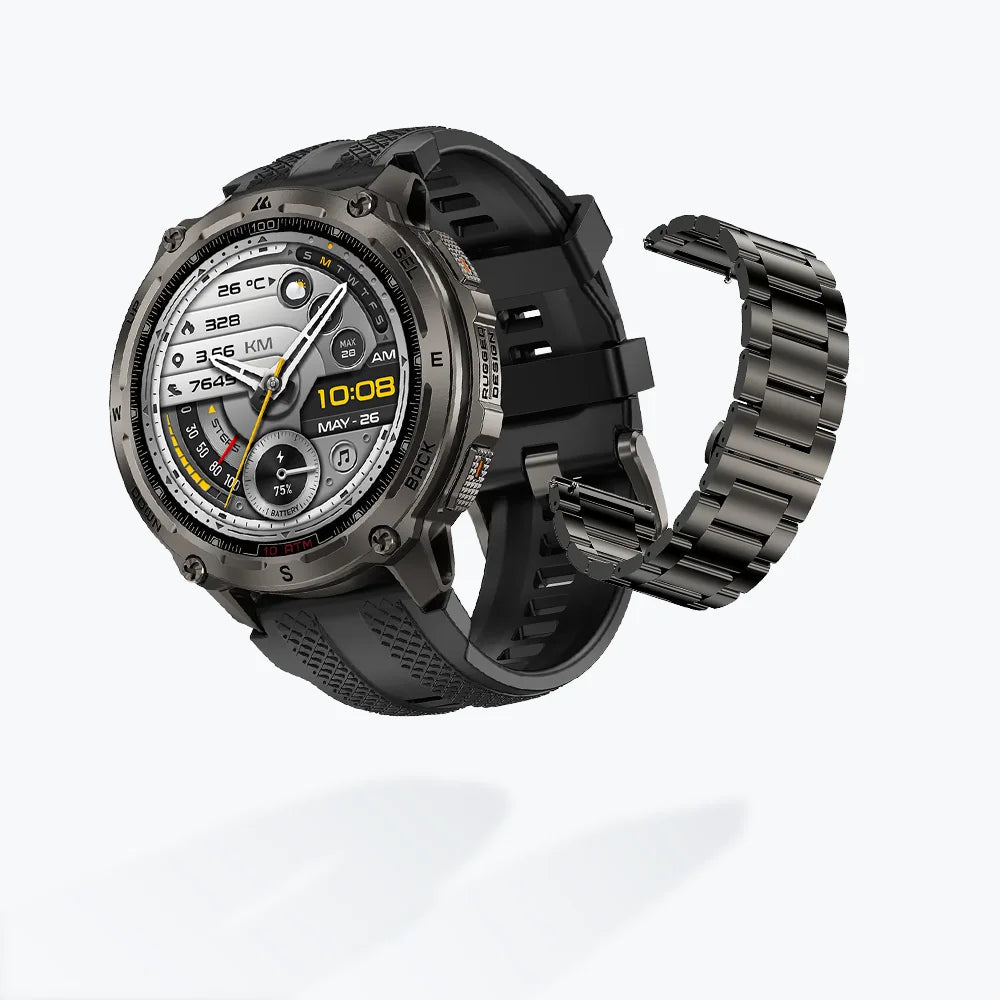
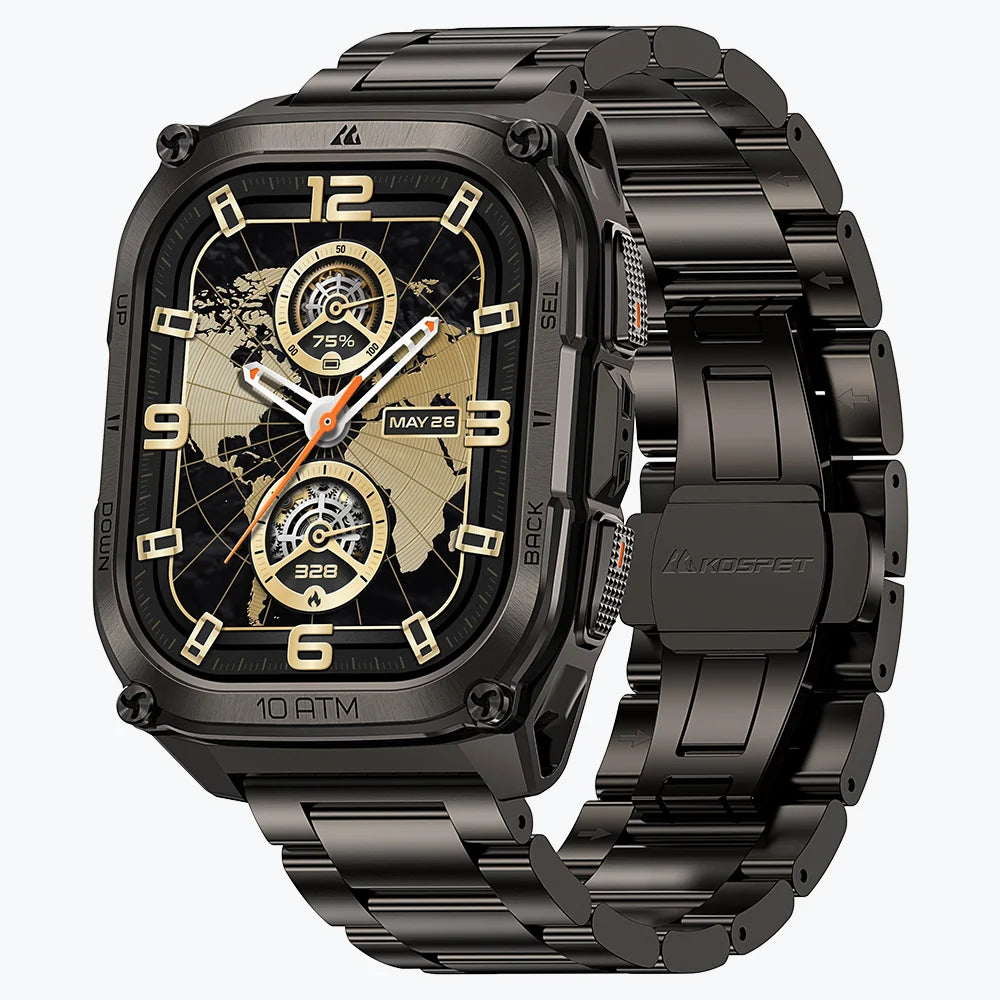
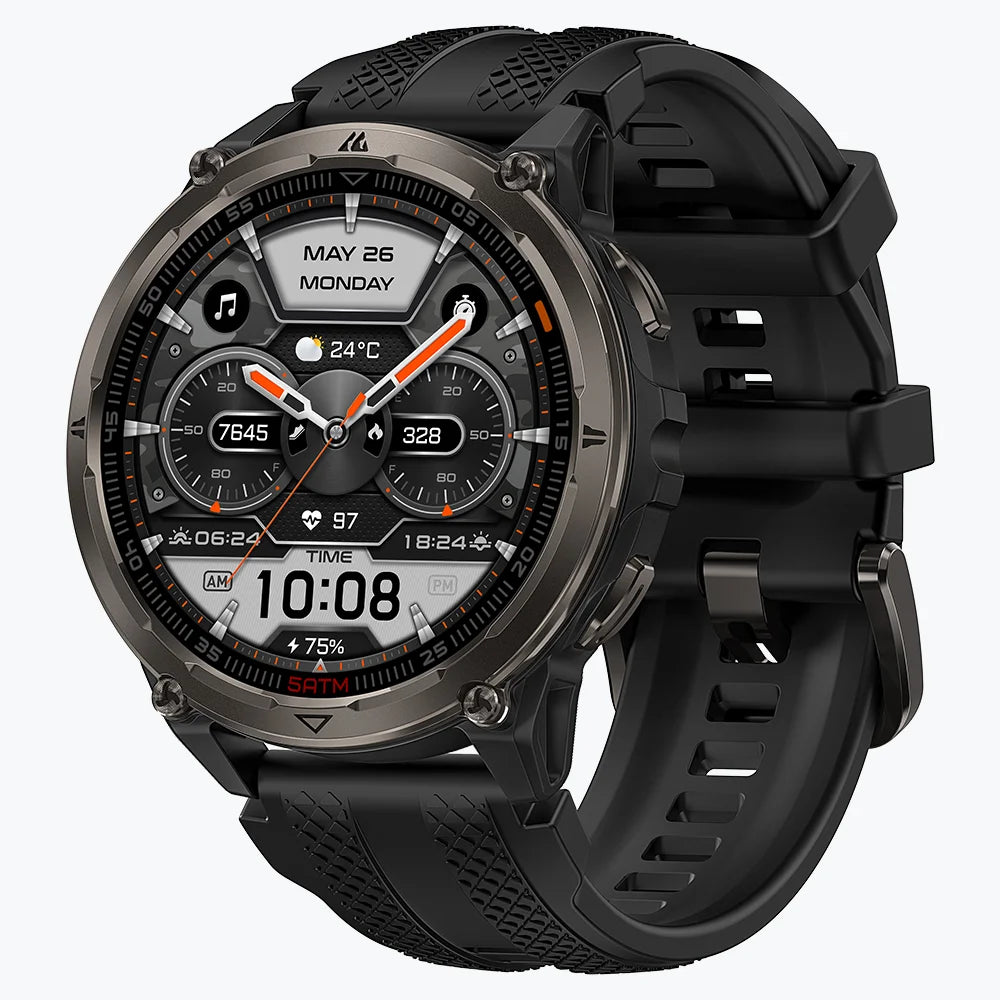

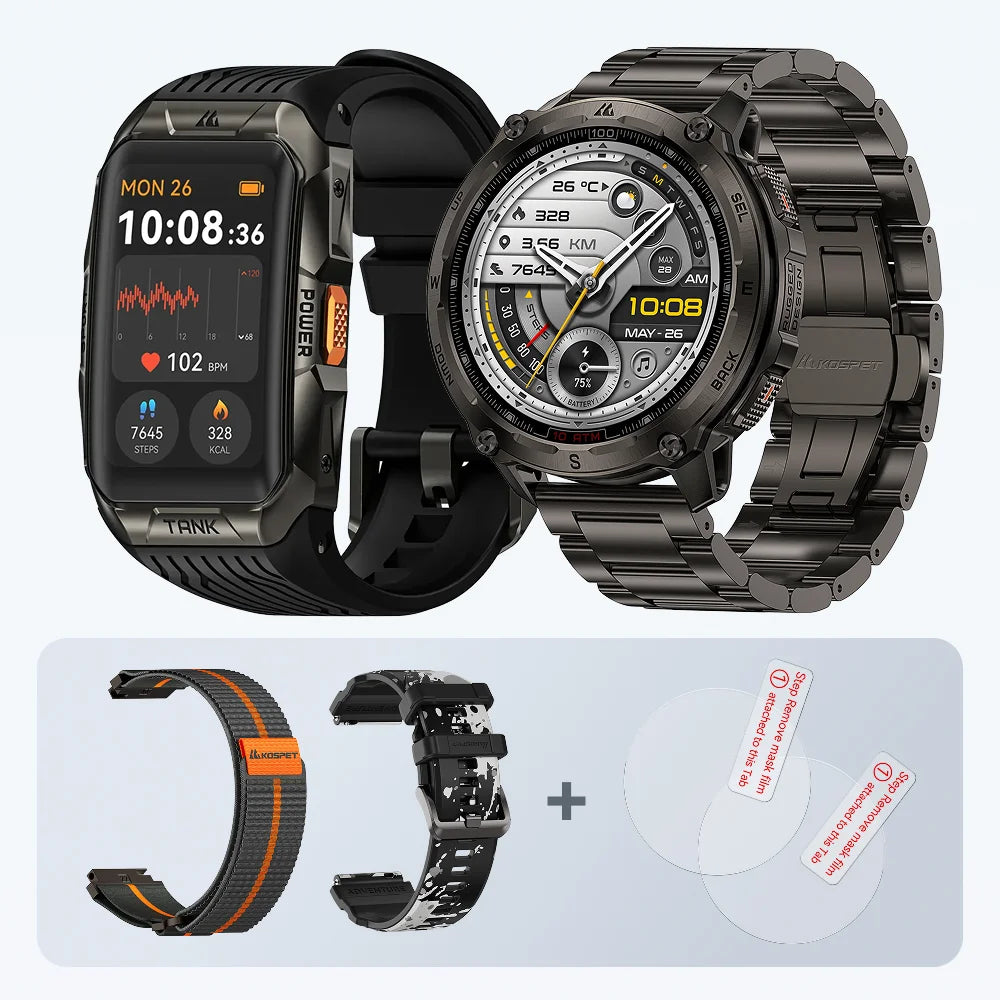
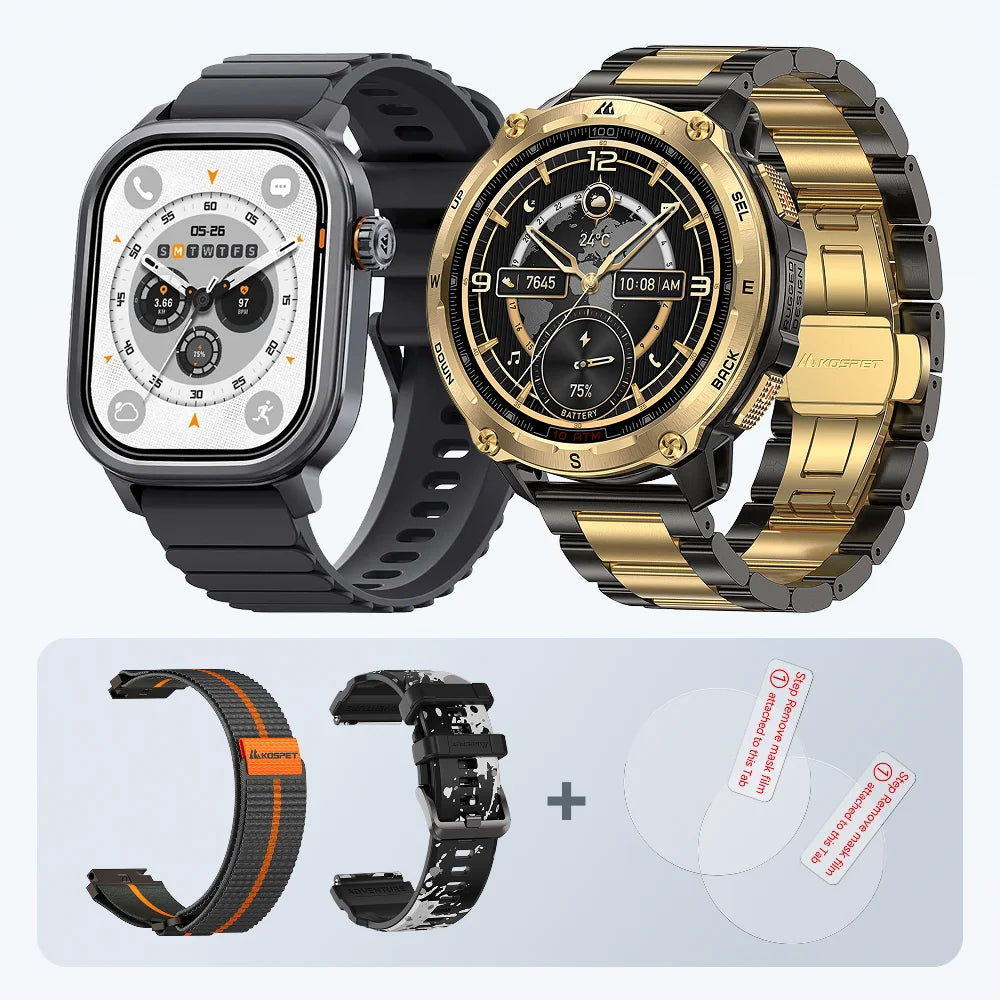
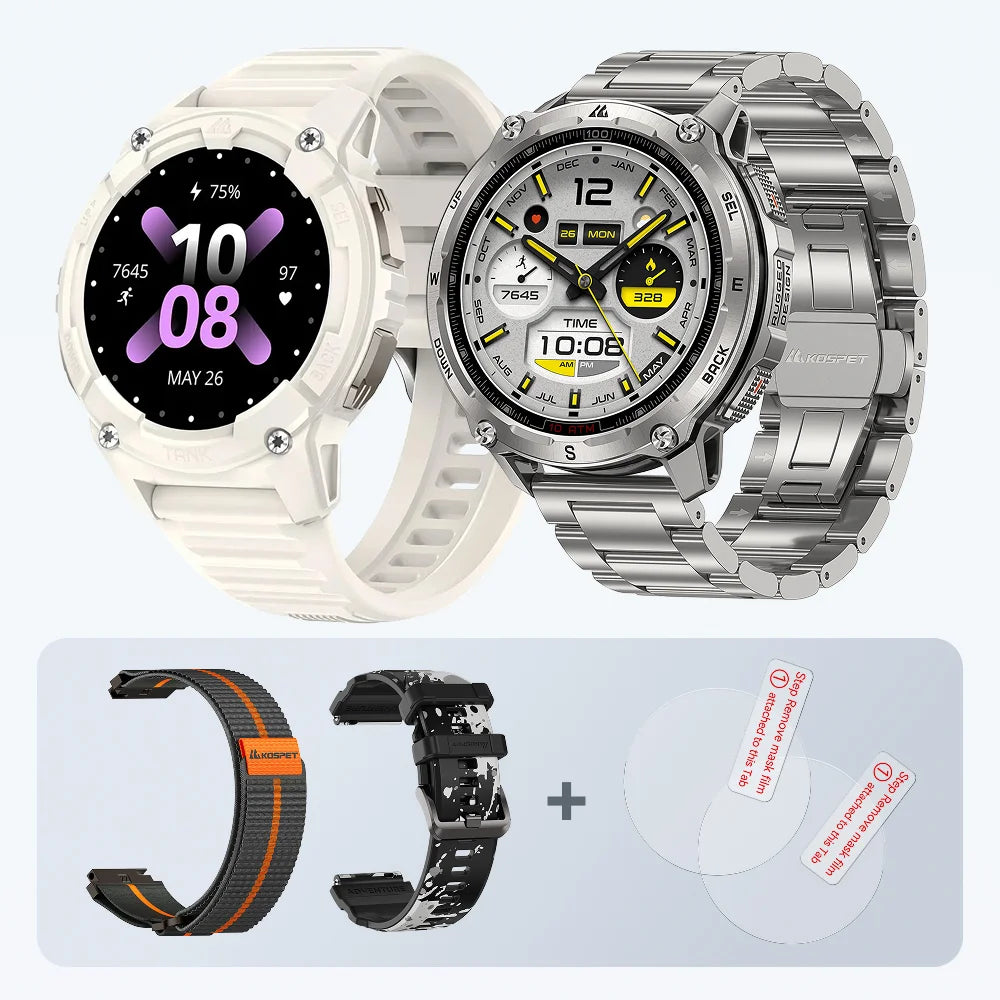
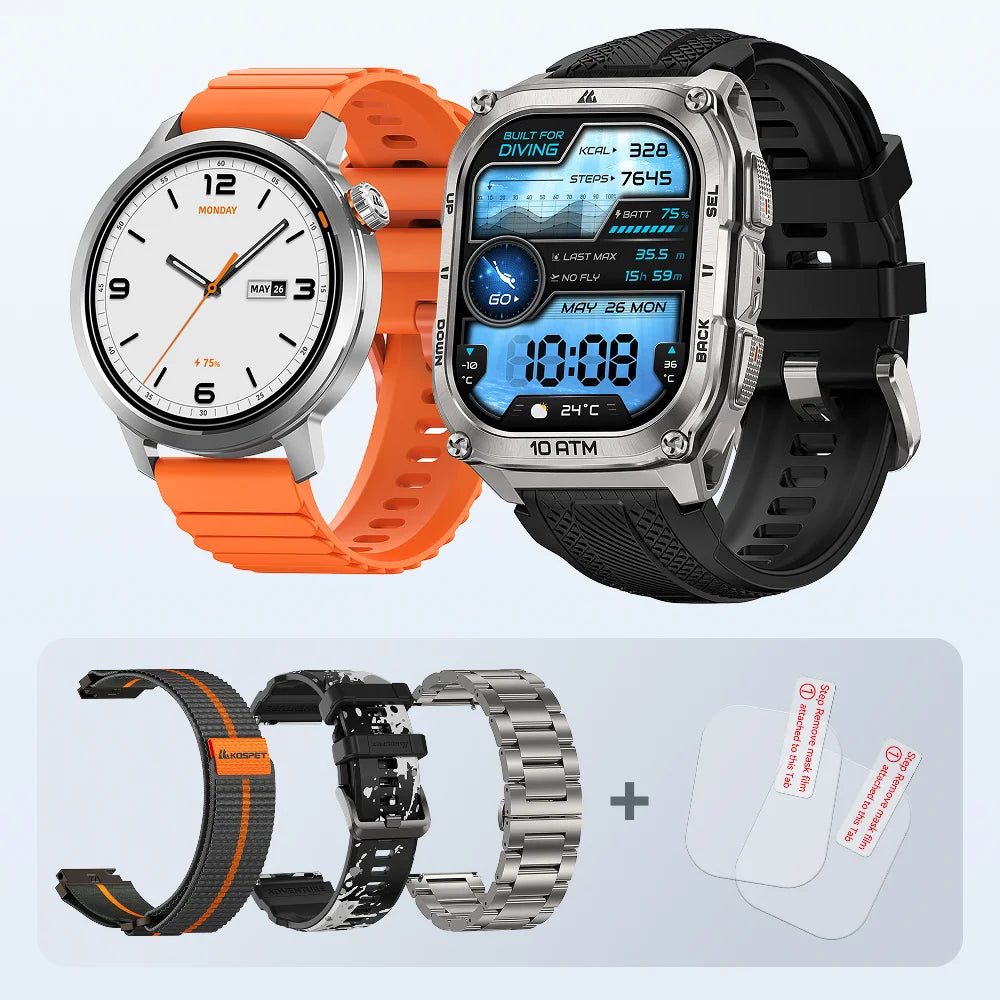
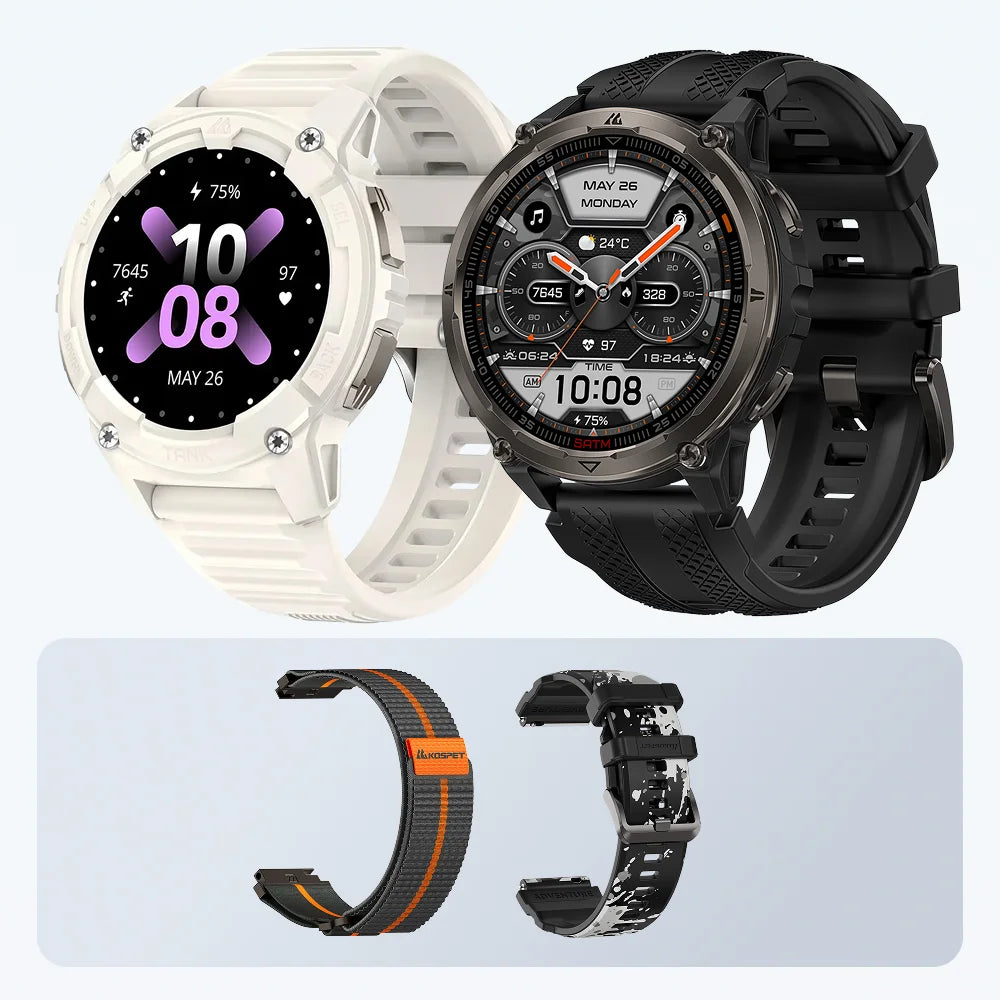
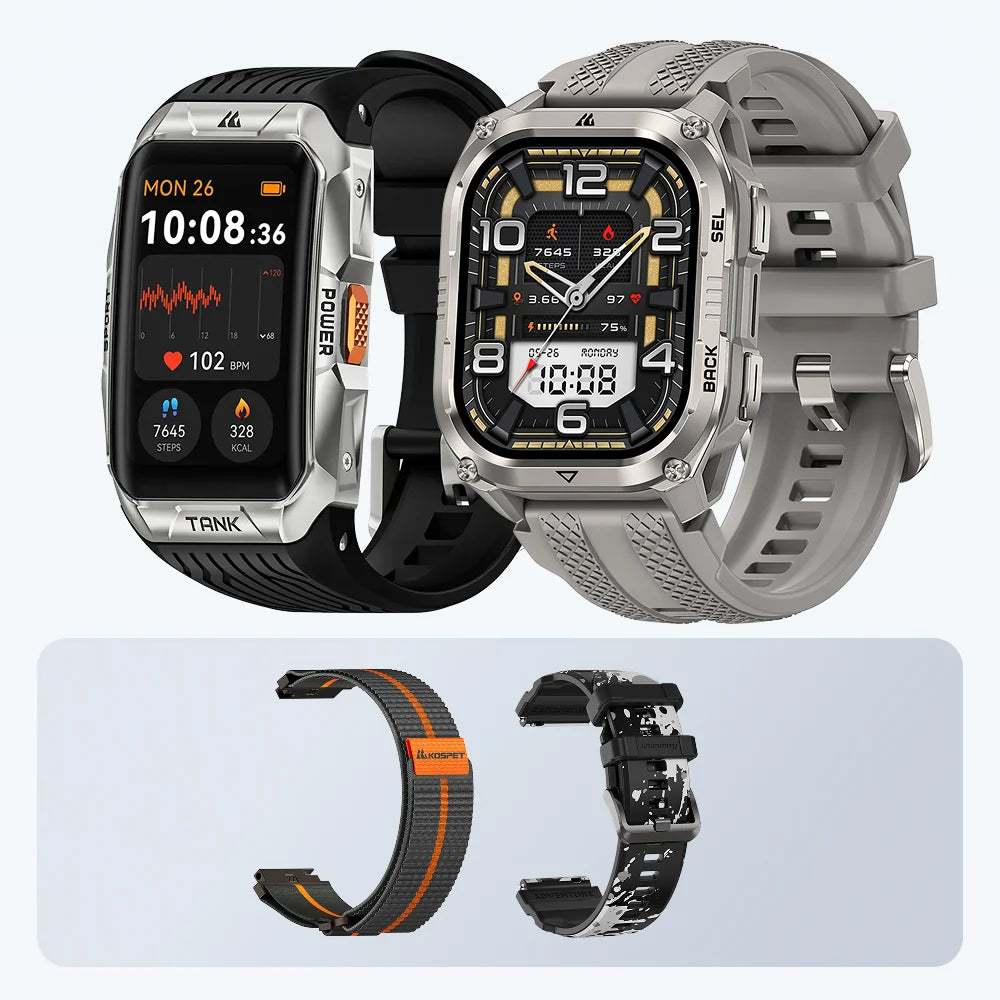
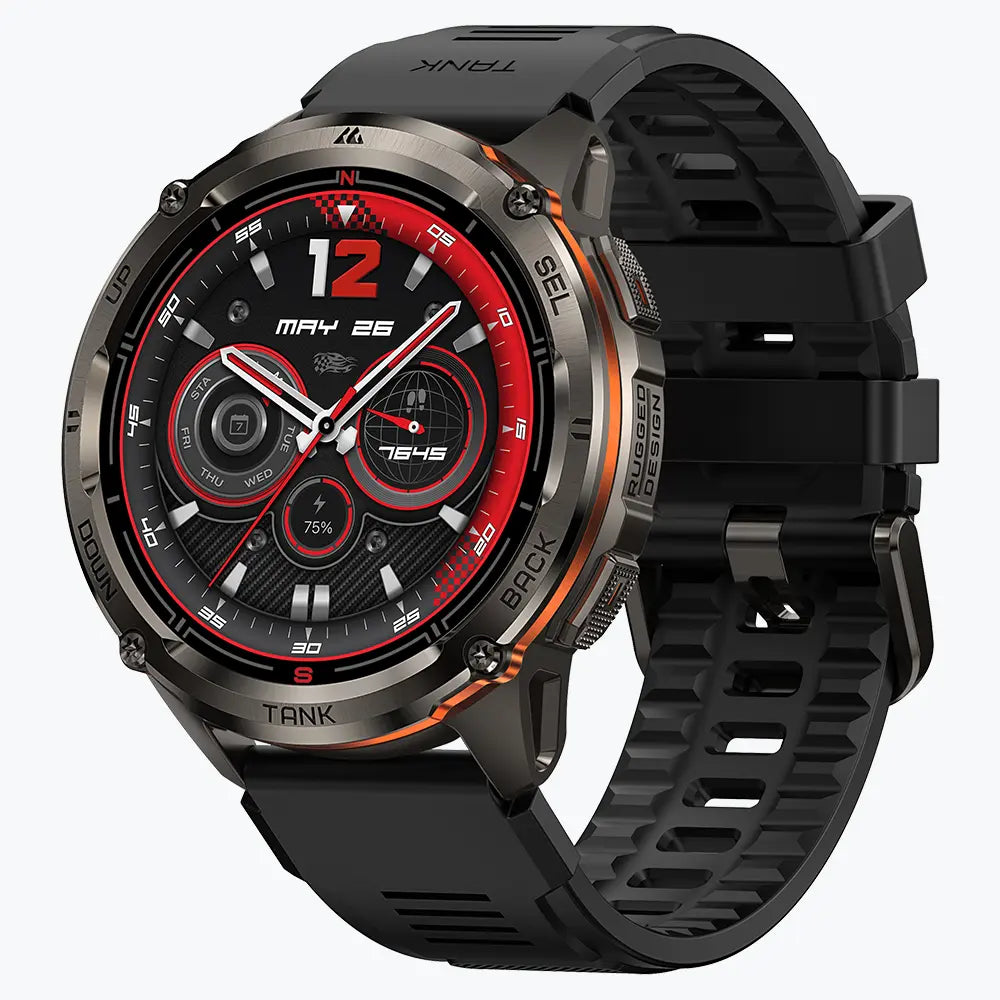
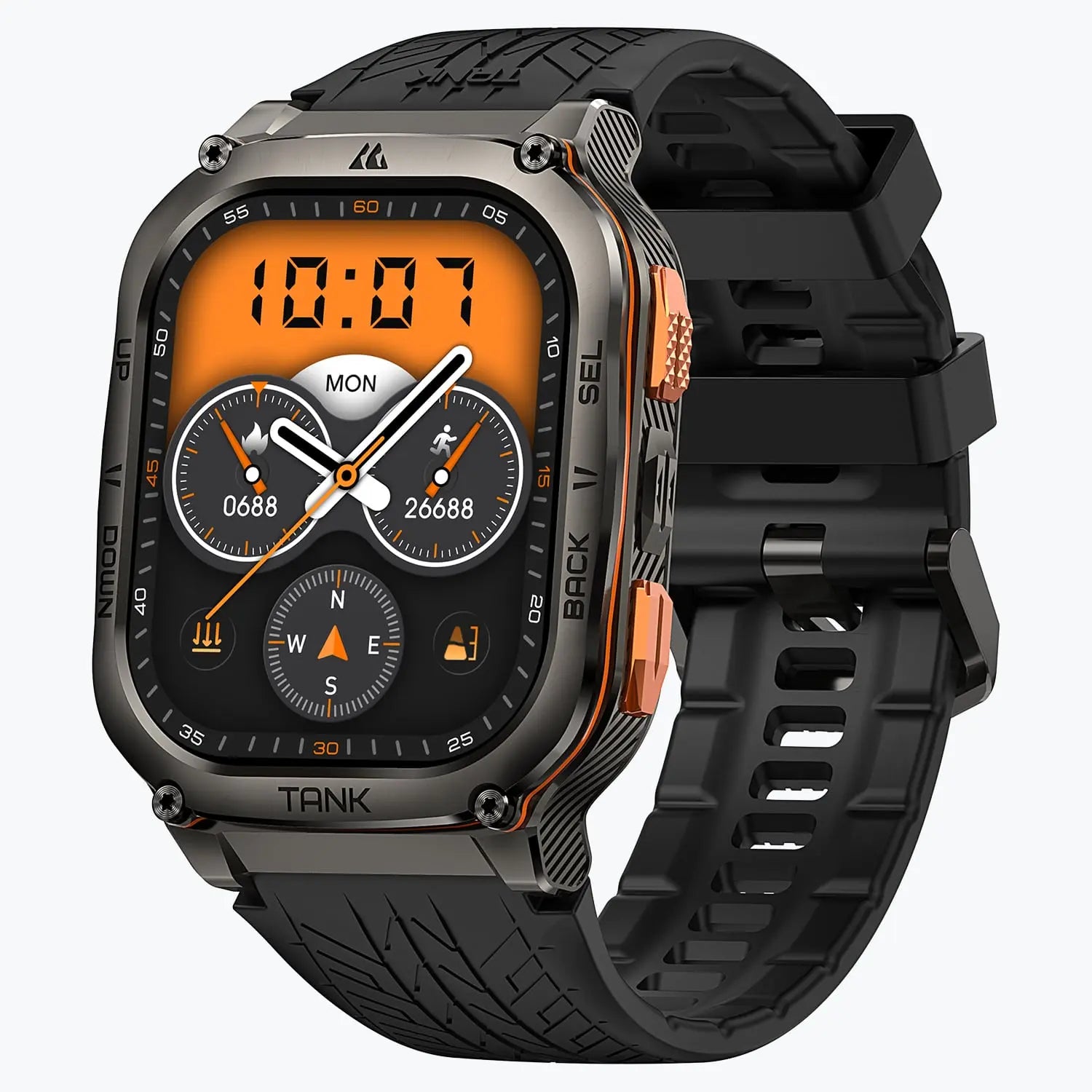


The right rugged smartwatch is the one designed to handle your workweek and meet the demands of your main outdoor activity without making you pay for capabilities you will not use.
Start with your harshest environment, longest GPS session, expected water exposure and wrist-size tolerance. Then treat navigation, battery, water resistance and comfort as activity-specific requirements. If you prefer a bold, armored design for both demanding work and weekends outdoors, use this rugged smartwatch guide to identify the features you genuinely need.

Which KOSPET Rugged Smartwatch Fits Your Adventure and Budget?
For most hikers, the KOSPET TANK T3 Ultra 2 is the value-and-GPS-endurance choice, while the KOSPET TANK T4 is the better match when offline maps are essential.
The TANK M3 Ultra fits surface swimming and mixed outdoor use, whereas the TANK M4 adds the water rating and dedicated modes required for recreational diving.
For rough work and weekend exploration, choose between the round TANK T4C and square TANK M4C according to display preference and wrist fit.
| Your primary activity | Recommended KOSPET model | Why it fits this use |
|---|---|---|
| Day hiking, trail running and long GPS recording | KOSPET TANK T3 Ultra 2 | Dual-band GNSS, Route Back, barometric altitude information and up to 35 hours of continuous GPS use |
| Backpacking and mountain routes where offline maps matter | KOSPET TANK T4 | Offline maps, GPX/KML route import, dual-band GNSS and a barometric altimeter |
| Surface swimming and mixed land-and-water activities | KOSPET TANK M3 Ultra | 5 ATM and IP69K ratings, a large square display and up to 35 hours of GPS tracking |
| Recreational diving and water-intensive adventures | KOSPET TANK M4 | 10 ATM water resistance, three dedicated dive modes and published diving guidance |
| Harsh work and weekend hiking with a round watch preference | KOSPET TANK T4C | Round display, built-in flashlight, dual-band GPS and 5 ATM/IP69K protection |
| Harsh work and weekend hiking with a larger square display | KOSPET TANK M4C | Larger square display, flashlight, dual-band GPS and 5 ATM/IP69K protection |
If two activities are equally important, select according to the more demanding one. Someone who hikes and occasionally swims should begin with hiking requirements. Someone who hikes and regularly dives must begin with diving requirements because inadequate water protection has more serious consequences.
Who Should Choose a Rugged Smartwatch for Work and Outdoor Adventures?
A rugged smartwatch is suitable for people who encounter dust, rain, mud, vibration or accidental knocks at work and still need navigation or activity information outside work. It is particularly relevant if you prefer a bold, protective-looking watch and are comfortable wearing a larger case throughout the day.
You are likely to benefit from one if:
- You work in construction, maintenance, field service, warehousing or another physically demanding environment.
- You hike, camp, swim, run trails or explore unfamiliar areas in your free time.
- You want GPS, compass, altitude or route information without constantly handling your phone.
- You prefer an armored case and prominent bezel over a slim conventional smartwatch.
- You are willing to trade some lightness and discretion for a more protective construction and easier-to-read display.
A rugged smartwatch may not be the right choice if you need an extremely light watch, have limited space under work gloves or sleeves, or cannot safely wear wrist accessories at work. It also cannot replace certified personal protective equipment, a dedicated diving computer or an emergency communication device.
A rugged appearance is not proof of durability. Look for documented water ratings, identified environmental test methods and published operating limitations rather than relying on the shape of the case or terms such as “military grade.”
What Should You Prioritize for Your Main Outdoor Adventure?
Prioritize the failure that would create the greatest problem during your main activity. On an unfamiliar trail, that may be losing the route. During an all-day activity, it may be battery depletion. In water, the documented water rating matters more than sports-mode count. At work, safe fit and workplace rules come before every smartwatch feature.
| Main activity | Most important risk | Features to prioritize | Features that are usually secondary |
|---|---|---|---|
| Day hiking or trail running | Missing a turn or exhausting the battery | Reliable GNSS, Route Back, readable screen, continuous-GPS runtime and comfortable fit | Dive functions, calls and an oversized display |
| Remote hiking or backpacking | Losing map context away from mobile coverage | Offline maps, route import, compass, barometric altitude and a charging plan | Voice functions and indoor sports modes |
| Mountaineering | Navigation errors and changing elevation | Offline route information, compass, barometric altimeter, physical backup navigation and cold-weather power planning | Decorative watch faces and notifications |
| Surface swimming or paddle sports | Water entering the case | Documented water rating, secure strap and controls that remain usable when wet | Offline maps and diving metrics |
| Recreational diving | Exceeding water or operating limits | Appropriate water rating, dedicated dive functions, clear depth limits and independent backup instruments | Long GPS runtime, because normal satellite positioning is unavailable underwater |
| Rough work plus weekend exploration | Damage, poor fit or unsafe wristwear | Environmental protection, secure fit, readable display, appropriate outdoor tools and workplace compliance | Features unrelated to either work or your primary adventure |
How should you define your outdoor-use profile?
Before comparing watches, write down four requirements:
- The longest time you expect to record GPS in one day.
- The deepest or most demanding water exposure you realistically expect.
- Whether you need a complete offline map or only a recorded route back.
- The largest watch you can comfortably wear under work clothing and outdoor equipment.
Use the most demanding realistic condition, not a hypothetical extreme that is unlikely to happen. Buying for unrealistic scenarios can increase cost and size without improving your normal experience.
If one trip combines several activities, follow the most safety-critical requirement. A hiking trip that includes surface swimming needs swimming-appropriate water resistance. A trip that includes recreational diving requires a watch specifically intended for that use.
Which Rugged Smartwatch Features Matter Most Outdoors?
The most important outdoor smartwatch features are navigation appropriate to the route, enough continuous-GPS battery life, a water rating suitable for the activity, a readable display and a case that remains comfortable throughout the trip. Durability claims are meaningful only when the manufacturer identifies what was tested.
Do dual-band GPS and offline maps improve outdoor navigation?
Dual-frequency GNSS can reduce some positioning errors by receiving more than one signal frequency. The official GPS.gov accuracy guidance explains that receiver accuracy also depends on satellite geometry, signal blockage, atmospheric conditions and hardware quality.
Dual-band positioning and offline maps solve different problems:
| Navigation feature | What it does | When it matters |
|---|---|---|
| Dual-band GNSS | Helps calculate position under more difficult signal conditions | Forests, urban areas, steep terrain and routes where track accuracy matters |
| Route Back | Guides you along a previously recorded track toward your starting point | Marked trails, runs and routes where retracing the same path is sufficient |
| Offline maps | Shows surrounding roads, trails and geographic context without an active mobile connection | Remote hiking, unfamiliar areas and routes with multiple junctions |
| GPX/KML route import | Lets you prepare and transfer a planned route before departure | Backpacking, organized routes and areas with unreliable coverage |
| Barometric altimeter | Estimates elevation changes using air-pressure data | Mountain routes where ascent and elevation trends are useful |
Offline maps do not guarantee successful navigation. Maps must normally be downloaded before departure, and routes still need to be checked for accuracy. The National Park Service advises visitors to download maps before entering areas with limited cellular coverage.
Satellite reception can also deteriorate under dense vegetation or in deep valleys. The National Park Service’s wilderness guidance warns that GPS units may not receive signals reliably in some heavily vegetated or steep areas.
Carry a phone, paper map or separate navigation device whenever losing the route could create a safety risk.
How much smartwatch battery life do you need for hiking?
Compare continuous-GPS runtime—not ordinary “typical use” battery life—with the longest activity you expect to record. A watch may last many days during normal use but considerably less when GPS, the display and navigation functions remain active.
A practical planning target is:
Minimum published GPS runtime ≥ longest planned GPS activity × 1.3
The additional 30% is an editorial planning buffer rather than a manufacturer guarantee or formal safety standard. It allows for differences caused by screen use, navigation settings, notifications, temperature and battery age.
For example, an eight-hour hike should not be planned around a watch rated for exactly eight hours of GPS use. Choose a watch with additional capacity, reduce unnecessary power consumption and retain a backup navigation method.
For multi-day trips, ask two separate questions:
- Can the watch complete the longest individual day?
- Can you reliably recharge it before the next day?
A long typical-use rating does not eliminate the need for a charging plan. Cold weather can also reduce the usable performance of lithium-based batteries, so winter trips require a larger reserve than mild-weather trips.
Is 5 ATM enough, or do you need 10 ATM water resistance?
A 5 ATM rating may be appropriate for surface swimming when the manufacturer specifically permits that use. A 10 ATM rating provides a more suitable starting point for higher-pressure water activities, but the number alone does not prove that a watch is suitable for scuba diving.
ISO 22810 covers water-resistant watches intended for ordinary use. ISO 6425 defines separate requirements and test methods for divers’ watches.
An ATM rating should not be converted directly into a safe diving depth. Real use can involve movement, impacts, changing pressure, temperature differences and deterioration of seals that are not represented by a simple depth calculation.
An IP rating covers enclosure protection against dust and water ingress under specified test conditions. The IEC explanation of IP ratings shows why an ingress-protection rating should not be treated as a replacement for a pressure rating or dedicated diving specification.
Use the following selection rule:
- Choose a swimming-permitted water rating for rain, sweat and surface swimming.
- Choose a higher water rating plus explicit diving functions and operating limits for recreational diving.
- Do not treat an IP rating alone as evidence that a watch is suitable for prolonged submersion.
- Follow the manufacturer’s instructions for water temperature, depth and button operation.
- Reassess water use after significant impact, case damage or servicing.
How do watch size and comfort affect outdoor performance?
Choose the largest display you can wear securely for an entire workday or outdoor activity—not simply the largest display available. An uncomfortable watch may be worn too loosely, removed during the activity or left behind.
Display size is not the same as total case size. Check the complete case length, width, thickness and strap range before choosing.
A suitable watch should:
- Sit fully on top of your wrist without extending excessively beyond its edges.
- Fit beneath work sleeves, jackets and gloves.
- Remain stable without requiring an excessively tight strap.
- Allow normal wrist movement during climbing, cycling or tool use.
- Avoid pressure points during several hours of continuous wear.
- Keep its buttons accessible without being pressed accidentally by gloves or cuffs.
Larger square screens can display more information, while round screens often provide a more traditional outdoor-watch appearance. Neither shape is automatically more comfortable or more durable.
If possible, compare the case dimensions with a watch you already own or create a paper template of the case footprint and place it on your wrist.
Does MIL-STD-810H mean a rugged smartwatch is indestructible?
No. MIL-STD-810H is a framework containing environmental test methods, not a universal guarantee that a product can survive every drop, temperature, vibration or corrosive environment.
The official MIL-STD-810H document listed by the U.S. Defense Logistics Agency focuses on tailoring laboratory tests to the environmental conditions a product is expected to encounter.
Manufacturers may use different methods and procedures from the standard. When evaluating a durability claim, check:
- Which test methods were performed.
- Whether temperature, impact, vibration or water limits are stated.
- Whether the complete watch or only part of it was evaluated.
- Whether the claim comes from the manufacturer or an independent laboratory.
- Which types of damage remain excluded from the warranty.
A watch that has passed selected environmental tests can still be damaged by conditions outside those tests. Chemical exposure, salt water, repeated impacts, damaged seals and extreme temperature changes require separate consideration.
How Do KOSPET TANK Rugged Smartwatches Compare?
KOSPET smartwatches are not arranged on a simple “more expensive means better” scale. The TANK T3 Ultra 2 prioritizes GPS endurance and value, the TANK T4 prioritizes offline navigation, the TANK M3 Ultra covers surface-water activities, the TANK M4 adds recreational diving capability, and the T4C/M4C pair focuses on rough work and weekend outdoor use.
KOSPET TANK T3 Ultra 2 vs. TANK T4: Which is better for hiking?
Choose the KOSPET TANK T3 Ultra 2 when longer published GPS runtime, Route Back and a lower price are more important. Choose the KOSPET TANK T4 when offline maps and imported routes are required for unfamiliar or junction-heavy terrain.
| Feature | KOSPET TANK T3 Ultra 2 | KOSPET TANK T4 |
|---|---|---|
| Best match | Day hiking, trail running and long GPS recording | Remote hiking, backpacking and offline route navigation |
| Positioning | Dual-band GNSS using six satellite systems | Dual-band GNSS |
| Navigation | Route Back, compass and barometric altimeter | Offline maps, GPX/KML import, compass and barometric altimeter |
| Published GPS runtime | Up to 35 hours | Approximately 21–22 hours |
| Water rating | 5 ATM and IP69K | 10 ATM and IP69K |
| Display | Round 1.43-inch AMOLED, up to 1,000 nits | Round 1.43-inch AMOLED, up to 1,000 nits |
| Published environmental testing | 15 MIL-STD-810H-related tests | 20 MIL-STD-810H-related test methods |
| Standard listed price* | $132.99 | $209.99 |
The TANK T4 is not automatically better for every hiker. If your phone or paper map already provides route context and longer GPS recording is more valuable, the TANK T3 Ultra 2 is the more logical option.
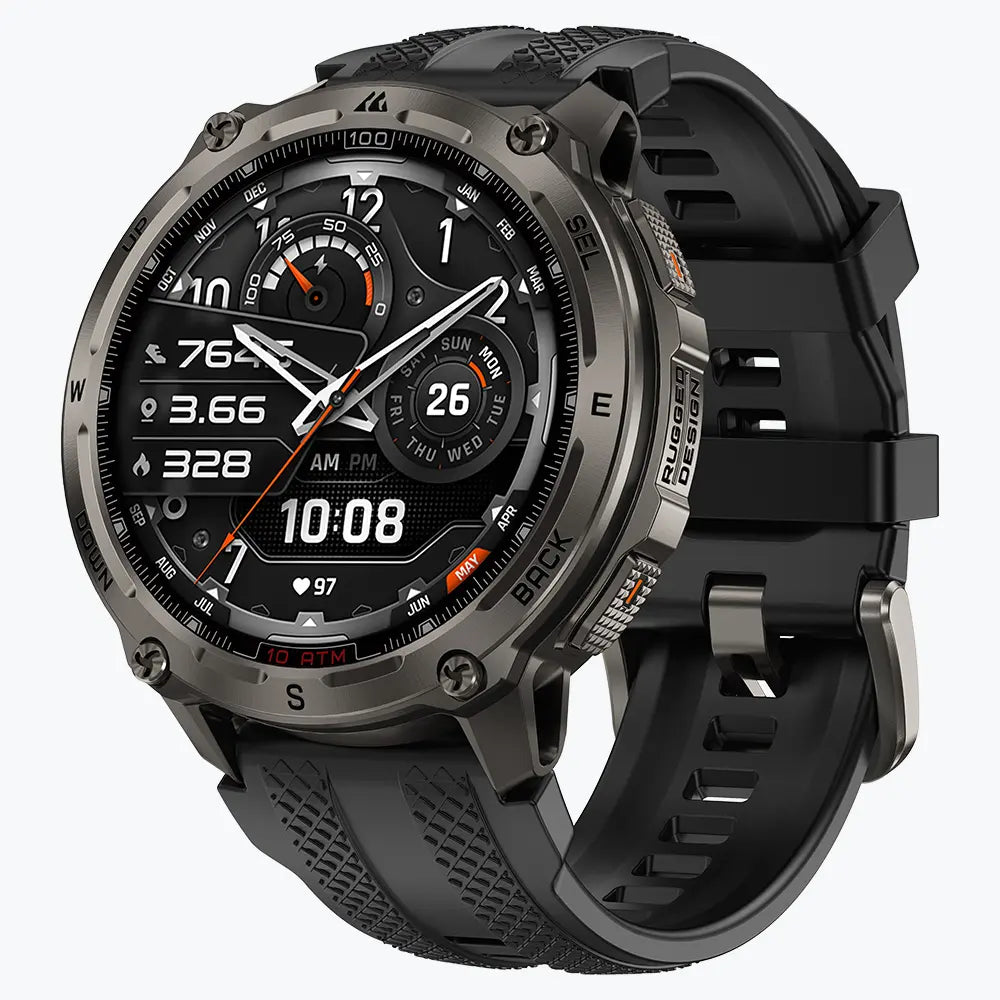
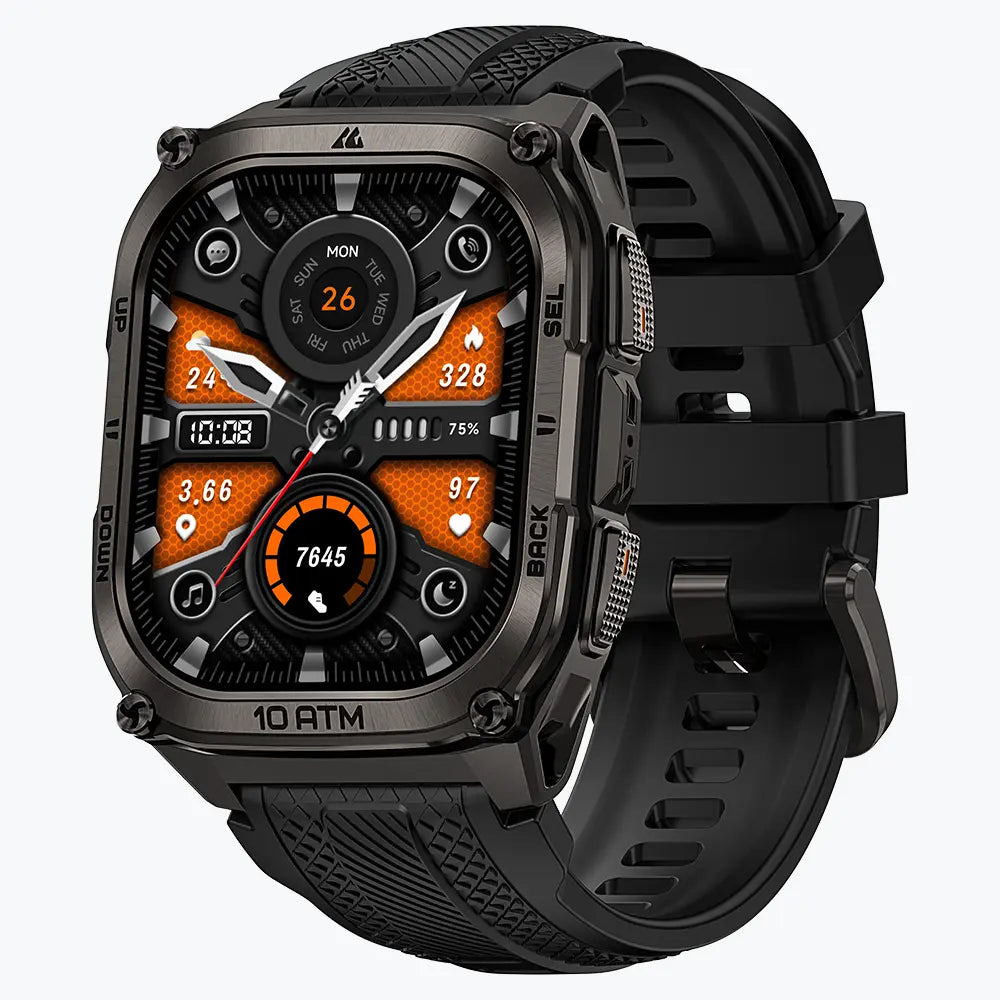
KOSPET TANK T4 Smartwatch
$300.00 CAD
If losing surrounding map context is your main concern, the TANK T4 justifies its higher price through offline maps and route import. Its shorter published GPS runtime means multi-day users still need a charging plan.
KOSPET TANK M3 Ultra vs. TANK M4: Which is better for water activities?
Choose the KOSPET TANK M3 Ultra for surface swimming and mixed outdoor use. Choose the KOSPET TANK M4 only when recreational diving is a genuine requirement and you understand its published depth and safety limits.
| Feature | KOSPET TANK M3 Ultra | KOSPET TANK M4 |
|---|---|---|
| Best match | Surface swimming and general outdoor use | Recreational diving and water-intensive adventures |
| Water rating | 5 ATM and IP69K | 10 ATM and IP69K |
| Dedicated dive functions | No dedicated diving suite highlighted | Three dedicated dive modes |
| Navigation | Dual-band GNSS using six satellite systems | Dual-band GNSS and offline maps |
| Published GPS runtime | Up to 35 hours | Approximately 21–22 hours |
| Display | Square 1.96-inch AMOLED, up to 1,000 nits | Square 1.96-inch AMOLED |
| Published environmental testing | 15 MIL-STD-810H-related tests | 20 MIL-STD-810H-related test methods |
| Standard listed price* | $132.99 | $209.99 |
Do not select the TANK M4 solely because 10 ATM sounds more durable. If your water activity stops at surface swimming, the TANK M3 Ultra covers the more relevant requirement at a lower price and provides longer published GPS runtime.
The TANK M4 product page states support for diving to 45 meters. However, KOSPET’s separate diving safety guidance recommends remaining within 40 meters and using backup depth, pressure and timing instruments. The more conservative safety guidance should govern actual use.
KOSPET TANK T4C vs. TANK M4C: Which is better for rough work?
The KOSPET TANK T4C and KOSPET TANK M4C provide similar work-and-outdoor functions. Choose the T4C for a traditional round appearance and smaller display; choose the M4C when you prefer a larger square screen and additional visual space.
| Feature | KOSPET TANK T4C | KOSPET TANK M4C |
|---|---|---|
| Case style | Round | Square |
| Display | 1.5-inch AMOLED, up to 1,000 nits | 1.96-inch AMOLED, up to 1,000 nits |
| Positioning | Dual-band GPS using six satellite systems | Dual-band GPS using six satellite systems |
| Outdoor information | Compass, altitude and air-pressure data | Compass, altitude, air-pressure and tide data |
| Water protection | 5 ATM and IP69K | 5 ATM and IP69K |
| Flashlight | Built-in LED flashlight with up to five published hours of continuous use | Built-in LED flashlight with up to five published hours of continuous use |
| Published GPS runtime | Up to 21 hours | Up to 21 hours |
| Published typical use | Up to 15 days | Up to 16 days |
| Standard listed price* | $159.99 | $159.99 |
Because their prices and primary functions are similar, wrist fit and screen shape should decide this comparison. The larger M4C display may make data easier to read, while the round T4C may fit people who prefer a more traditional rugged-watch appearance.
Neither model is specifically intended for recreational diving. Their 5 ATM rating makes them more appropriate for rough work, hiking and manufacturer-permitted surface-water use.
*All prices in this section were observed on the linked U.S. product pages on August 24, 2026. Verify current pricing, configuration and regional availability before publication.
Can You Wear a Rugged Smartwatch in Every Harsh Work Environment?
No. Resistance to dust, water and physical wear does not make a smartwatch safe around exposed electrical conductors, rotating machinery, saws or other entanglement hazards. Employer rules and established safety procedures must override convenience.
Can you wear a smartwatch during electrical work?
OSHA’s electrical safety standard 29 CFR 1910.333 restricts conductive articles of jewelry and clothing when they might contact exposed energized parts.
A smartwatch may contain a metal case, buckle or other conductive components. Remove it whenever the work procedure, risk assessment or site policy requires wrist accessories to be removed.
A water or durability rating does not provide electrical insulation.
Can a smartwatch create an entanglement risk?
Yes. Any wrist accessory can create an additional snagging risk near exposed moving machinery. OSHA’s machine-guarding guidance identifies hazards associated with rotating parts, moving equipment and points of operation.
Remove the watch if it could:
- Contact rotating or moving components.
- Catch on equipment or materials.
- Interfere with protective gloves.
- Prevent correct use of another item of personal protective equipment.
- Conflict with the employer’s safe-work procedure.
This risk depends on the task and equipment, so site-specific rules must be followed.
Do water ratings cover chemicals, steam and hot water?
Not necessarily. Water-resistance and IP tests are performed under defined conditions. They should not be interpreted as automatic resistance to solvents, fuels, corrosive chemicals, steam or repeated high-temperature exposure.
Follow the manufacturer’s cleaning and operating instructions after exposure to mud, salt water or industrial substances. Stop using the watch in water if its screen, buttons, case or seal area has been damaged.
A rugged smartwatch can support navigation and activity tracking, but it remains electronic equipment. It is not personal protective equipment and should never override workplace safety requirements.
FAQ
Can a rugged smartwatch work without a phone or cellular service?
Basic GPS positioning can work without a phone or cellular connection because the watch receives positioning signals from satellites. However, downloading maps, transferring routes, checking weather and syncing activity records may still require internet access or a connected phone.
Download maps and routes before leaving coverage. GPS.gov explains the satellite-based positioning system, while the National Park Service recommends downloading maps before entering areas with limited cellular service.
How much smartwatch battery life do I need for a three-day hike?
You do not necessarily need 72 hours of continuous GPS runtime. You need enough GPS battery for the longest individual day, plus a reserve and a reliable way to recharge before the next day.
If you expect to record eight hours per day, choose a published GPS runtime that comfortably exceeds eight hours under your intended settings. Bring appropriate charging equipment and keep a physical navigation backup. The National Park Service’s Ten Essentials recommends carrying navigation tools, a physical map and extra battery capacity for essential electronics.
Can a rugged smartwatch replace a dedicated GPS or diving computer?
No. A rugged smartwatch should be treated as a convenient information tool rather than your only safety instrument.
For remote travel, carry a map and compass or another independent navigation method. For diving, use equipment appropriate to your training, depth and dive plan. ISO 6425 defines specific requirements for divers’ watches, and a general water-resistance rating does not automatically establish compliance.
Use independent navigation, communication, depth and timing equipment whenever watch failure could leave you stranded or create a serious safety risk.