

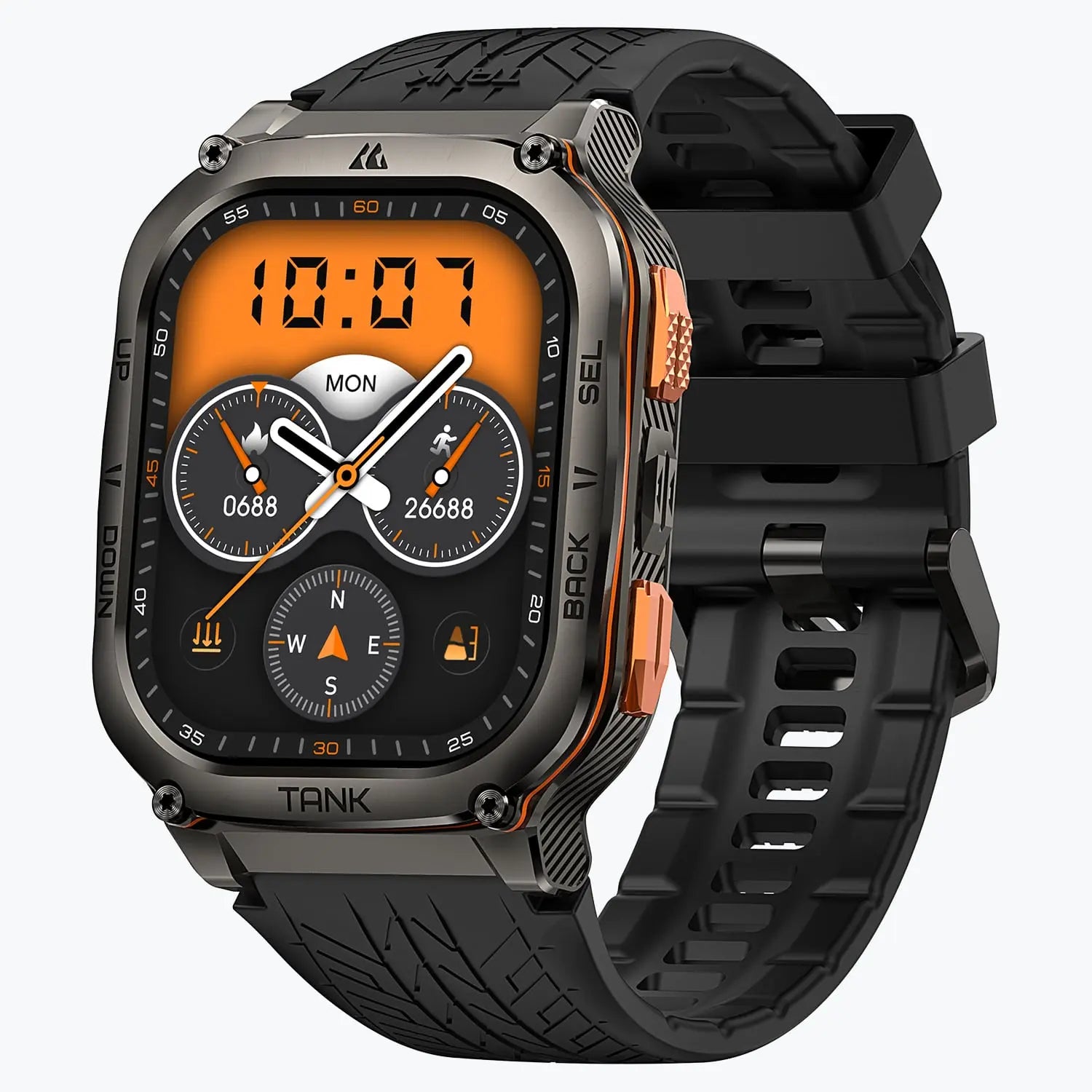


You do not need to reach a certain pace or distance before buying a running watch. The decision depends on whether it solves a problem your phone no longer handles well.
A running watch starts to make sense when:
- Checking your phone interrupts your run.
- You need help managing run-walk intervals.
- You often start too fast and need real-time feedback.
- You want to track outdoor runs without carrying a phone.
- Your training plan includes timed workouts or pace targets.
- You use workout data to adjust future training.
For runners who only review time, distance, and route after a workout, a phone remains the simpler and more affordable choice.

Start With Your Running Habit, Not the Watch
When you first begin running, consistency matters more than detailed performance data.
The early goal is to establish a manageable routine, control the effort, and increase training gradually. The CDC recommends starting slowly and progressing toward longer or more challenging activity over time.
A watch does not create that habit. It only supports it.
Buying a running watch before you know whether you enjoy running often leads to unused features and unnecessary spending. Buying one after the same training problem appears week after week gives the device a clear purpose.
There is no fixed waiting period. Running two or three times a week is not a requirement. It is simply a sign that you will use the watch often enough to benefit from it.
Ask one practical question:
What becomes easier on my next run because I am wearing this watch?
If the answer is unclear, keep using your phone.
A Phone Is Enough for Basic Run Tracking
A phone already handles the basic needs of a new runner:
- Total running time
- Distance
- Average pace
- GPS route
- Music
- Emergency communication
This setup works well when you carry the phone comfortably and only review the results after finishing.
The limitation appears when you need to interact with the device while moving.
Taking a phone out of a pocket, unlocking it, and reading a small screen breaks concentration. The problem becomes more noticeable with sweaty hands, in the rain, during faster intervals, or when the phone sits inside a running belt.
Audio updates help, but they provide limited control. You still depend on spoken prompts, and changing a workout often requires stopping or handling the phone.
A running watch removes this friction by placing the most important information on your wrist. The benefit is not more data. The benefit is faster access to the right information at the right moment.
The Strongest Reasons to Buy a Running Watch
You Struggle to Follow Run-Walk Intervals
Many beginner plans alternate running and walking.
A workout might ask you to:
- Run for three minutes.
- Walk for two minutes.
- Repeat the sequence six times.
Managing this manually creates unnecessary work. You have to remember each interval, watch the clock, or repeatedly check an app.
A running watch handles the timing automatically. Vibration and sound alerts tell you when to run, walk, recover, or begin the next repetition.
This solves a real beginner problem: staying focused on movement and breathing instead of counting minutes.
Interval alerts also remain useful as training progresses. The same system supports warm-ups, short faster efforts, recovery periods, and time-based workouts.
You Regularly Start Too Fast
A new runner often feels strong during the first few minutes and increases the pace too early. Breathing then becomes difficult, the pace drops, and the final part of the run feels unnecessarily hard.
A watch makes this pattern visible.
Real-time pace shows when the opening speed is higher than planned. Heart-rate data provides another indication that the effort is rising. Lap pace gives a more stable view than reacting to every change in instant GPS pace.
The watch does not replace physical awareness. The talk test remains one of the simplest ways to judge exercise intensity. Steady conversation generally corresponds with moderate effort, while vigorous effort limits speech to only a few words.
For beginners, the best approach combines both:
- Use pace and heart rate as feedback.
- Use breathing and perceived effort as the final check.
The watch identifies a pattern. Your body determines whether the effort is appropriate.
Checking Your Phone Disrupts Your Run
Some runners have no problem carrying a phone. Others constantly adjust it, worry about dropping it, or dislike the weight moving inside a pocket.
This is one of the clearest buying signals because the frustration already exists.
A watch with built-in GPS records the route, distance, and pace without using the phone’s GPS. You check the screen with a quick glance and control the workout from your wrist.
However, phone-free GPS tracking is not the same as complete phone independence.
Before leaving your phone at home, decide which functions you still need:
- Calls or messages
- Live location sharing
- Emergency contact features
- Streaming music
- Turn-by-turn navigation
A standard GPS watch records the workout independently, but communication and online features often still depend on a connected phone or cellular service.
Buy according to the functions you use, not the phrase “phone-free running.”
Your Training Plan Requires Real-Time Guidance
A beginner 5K or 10K plan becomes easier to execute when the watch displays the next step instead of forcing you to memorize the session.
Useful instructions include:
- Warm up for ten minutes.
- Stay within an easy pace range.
- Complete six short intervals.
- Recover for a fixed period.
- Cool down before stopping.
The value comes from execution, not from the size of the training library.
A watch that reliably delivers the correct alert during the workout is more useful to a beginner than a watch that produces dozens of advanced performance scores afterward.
You Use Data to Change Your Training
Collecting data is not the same as using it.
A watch becomes worthwhile when the information leads to a clear decision, such as:
- Slowing down after several overly fast starts
- Keeping easy runs at a conversational effort
- Increasing run intervals gradually
- Taking more recovery after unusually difficult sessions
- Comparing similar routes across several weeks
- Checking whether training is becoming more consistent
Single-run numbers often create confusion. Weather, sleep, hills, stress, and fatigue all affect pace and heart rate.
Look for trends instead:
- The same route feels easier.
- Your pace becomes steadier.
- You complete longer intervals without excessive fatigue.
- Your weekly running time increases gradually.
- Recovery between sessions improves.
Data has value when it changes an action. When you never review it, advanced tracking adds complexity without improving the run.
What a Running Watch Does Not Solve
A running watch removes friction, but it does not replace the fundamentals of training.
It does not:
- Create motivation after the initial excitement fades
- Prevent every injury
- Know exactly how tired you feel
- Guarantee accurate heart-rate readings in every condition
- Measure calories precisely
- Replace gradual progression and recovery
- Turn a poor training plan into a good one
Wrist-based heart-rate accuracy varies between devices, activities, speeds, fit, and individual users. Reviews of commercial wearables also find that calorie expenditure is less reliable than heart-rate measurement.
Treat heart rate as a trend rather than a medical result.
A sudden abnormal reading often comes from loose contact, cold skin, wrist movement, or poor sensor placement. Persistent symptoms require professional medical advice, not a conclusion from a watch screen.
The watch provides evidence. The runner still provides judgment.
What Features Does a Beginner Actually Need?
Beginner runners rarely need the longest feature list. They need reliable basics that directly address the problems above.
Built-In GPS
Confirm that the watch has built-in GPS rather than connected GPS.
Connected GPS uses the phone’s location signal. It works when you always carry the phone, but it does not solve the problem of phone-free tracking.
Built-in GPS records outdoor distance, pace, and route directly from the watch.
A Readable Workout Screen
During a run, more information does not mean better information.
A useful beginner screen shows:
- Elapsed time
- Distance
- Pace
- Heart rate
Crowding the screen with cadence, elevation, calories, training effect, and other metrics makes the important numbers harder to read.
Choose clarity over quantity.
Reliable Controls
Sweat, rain, gloves, and movement reduce touchscreen accuracy.
Physical buttons provide dependable control for starting, pausing, recording a lap, and changing screens. A touchscreen still works well for menus and everyday use, but workout controls need to remain predictable.
The best interface is one you can operate without stopping.
Interval and Training-Plan Support
Run-walk alerts and customizable intervals deliver more immediate value than advanced race predictions.
Check whether the watch:
- Supports work and recovery intervals
- Repeats the sequence automatically
- Uses vibration as well as sound
- Accepts custom workouts
- Syncs with the training platform you use
Comfortable Fit
A heavy or poorly fitted watch moves on the wrist, becomes distracting, and weakens heart-rate sensor contact.
Check the case dimensions, total weight, strap material, and wrist-size range. A secure fit should not require overtightening the strap.
Comfort is not an extra. It determines whether you keep wearing the product.
Practical Battery Life
A beginner does not need expedition-level battery life. The watch needs enough power to cover normal weekly training without becoming another device that requires daily attention.
Battery matters more when you:
- Track sleep overnight
- Wear the watch all day
- Use continuous GPS frequently
- Store or control music
- Forget to charge devices regularly
Beginner-Friendly Running Watch Recommendations
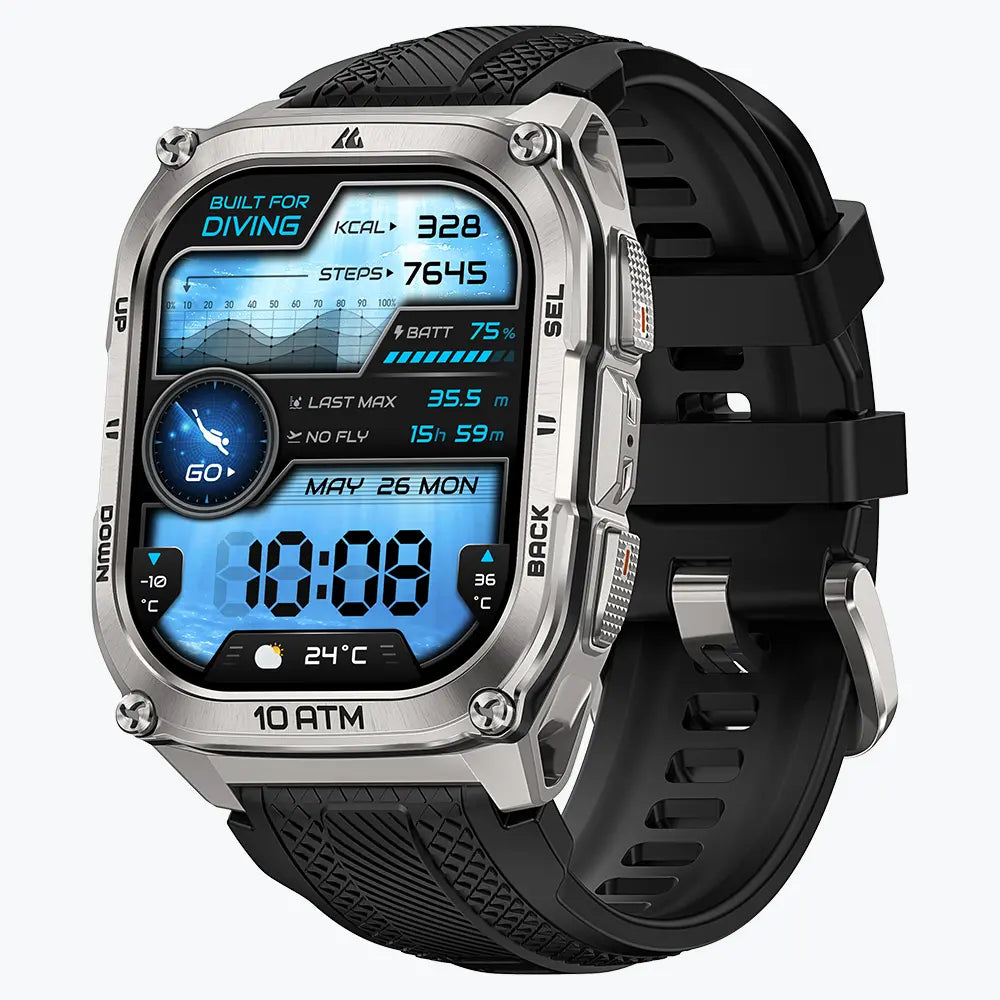
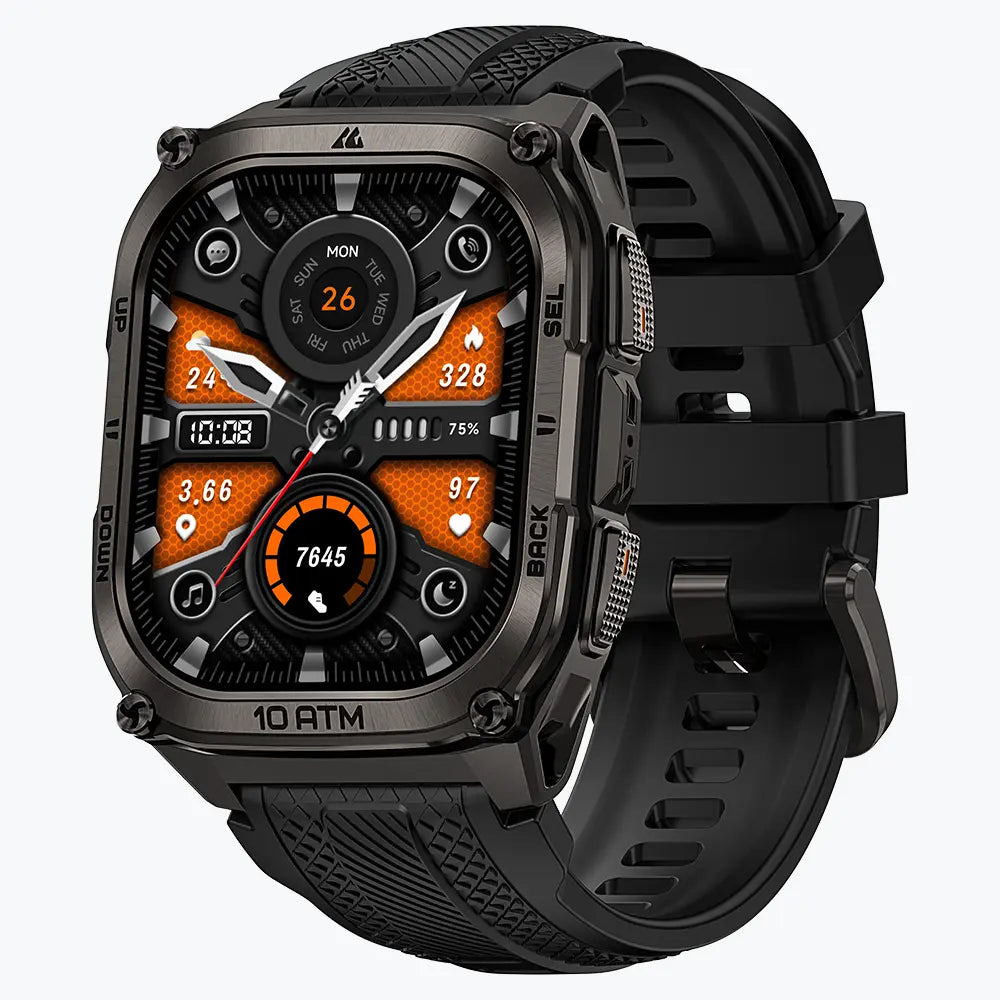
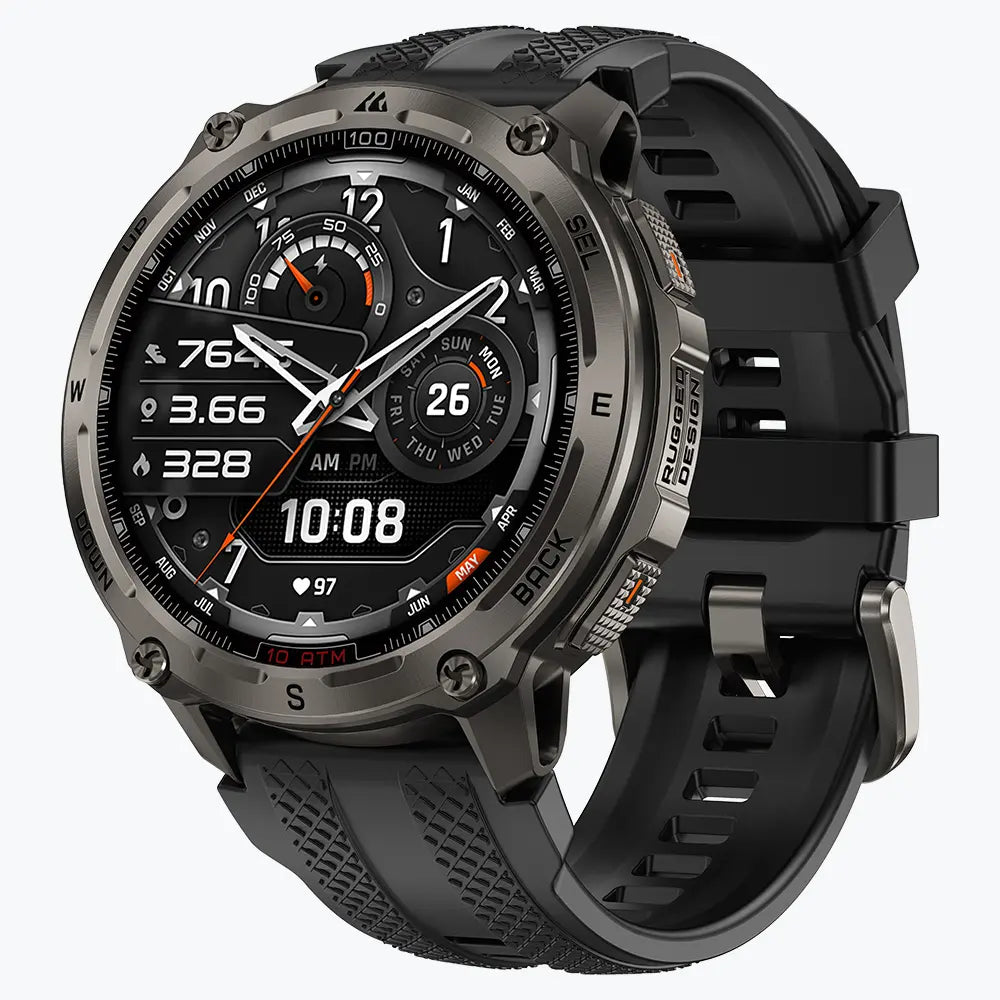
The KOSPET TANK T4 and MAGIC P10 address different beginner needs. Choose according to where you run and what currently disrupts your training.
KOSPET TANK T4: For Outdoor Routes and Less Phone Dependence
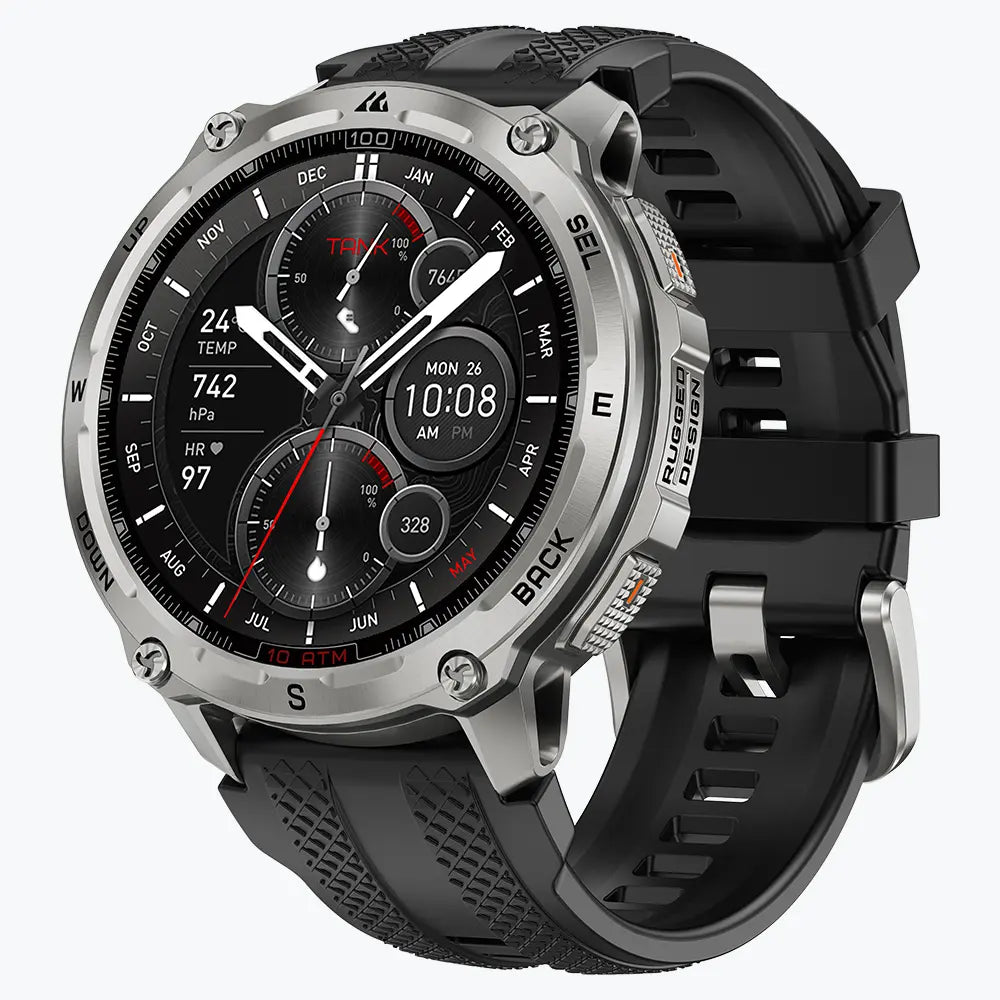
កូស្ពេត TANK នាឡិកាឆ្លាតវៃ T4
$209.99 USD
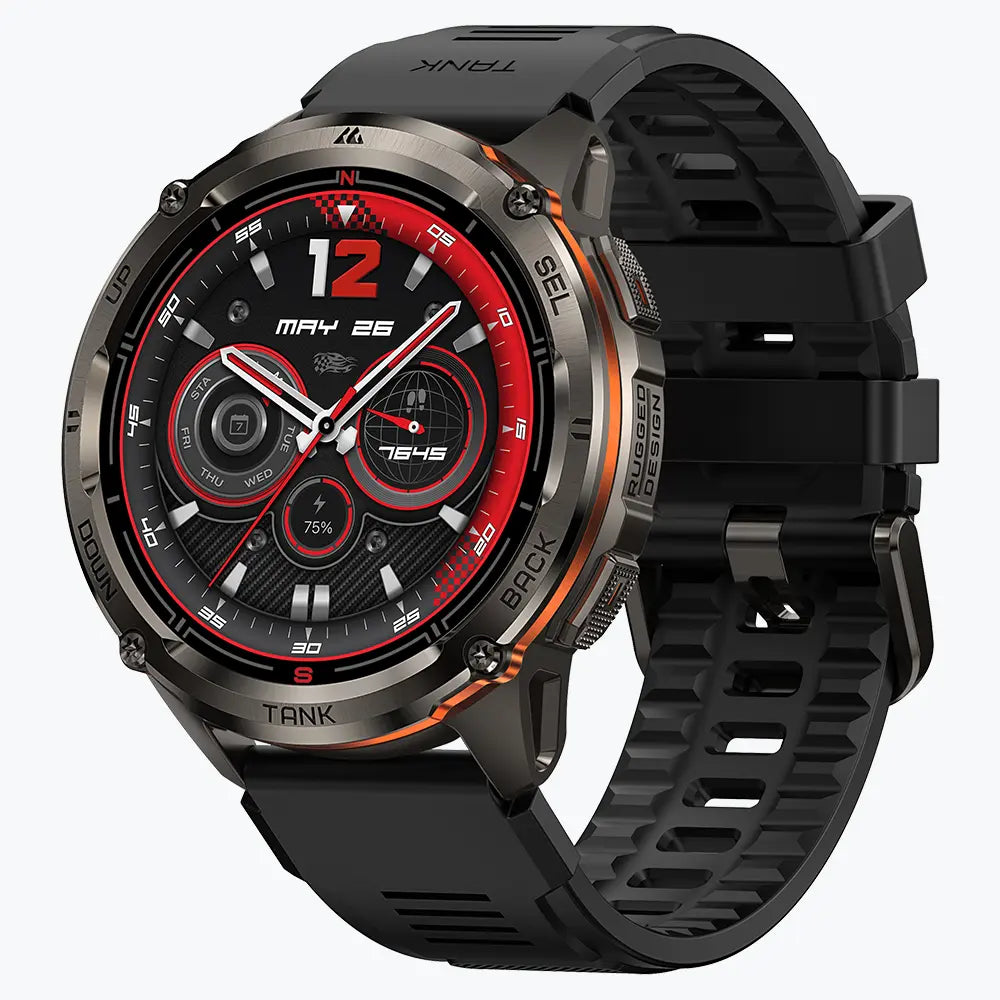
The TANK T4 fits beginners who spend more time outdoors, run unfamiliar routes, or want navigation and music without constantly relying on a phone.
- Your GPS route becomes unreliable near buildings or trees: Dual-band, six-system GNSS improves positioning for pace, distance, and route recording in challenging outdoor environments.
- You hesitate to explore unfamiliar routes: Offline maps and GPX or KML route imports keep your planned course on the wrist. You see the route without opening a phone or depending on a mobile signal.
- You carry a phone mainly for music: The 32 GB internal storage holds local music alongside offline map files, reducing phone dependence during training.
- Long GPS sessions drain your current device: KOSPET rates the watch for up to 22 hours of continuous GPS use and up to 15 days of typical use.
- Rain, water, dust, and rough use concern you: The stainless-steel construction, 10 ATM and IP69K ratings, and MIL-STD-810H testing make the watch suitable for demanding outdoor conditions.
The TANK T4 is the better option for road-to-trail running, long outdoor sessions, route navigation, and runners who want local music storage.
Its rugged build also creates a trade-off. The watch weighs 77 grams without the strap and has a 48.6 mm case, so runners who prefer a light, compact device should check the fit before choosing it.
KOSPET MAGIC P10: For Everyday Runs and Structured Beginner Workouts
The MAGIC P10 fits beginners who mainly run on roads, train in the gym, and want one watch that works during workouts and throughout the day.
- You do not know how to structure each workout: Custom training plans provide defined goals and reduce the need to create every session manually.
- Your route and pace data drift during city runs: Dual-band GNSS improves outdoor positioning and gives beginners a clearer record of distance and pace.
- Sweat or rain makes the touchscreen difficult to use: Wet-touch support keeps the screen responsive when the surface is wet.
- You want an easy-to-read display: The 1.96-inch AMOLED screen provides more space for pace, distance, heart rate, and workout instructions.
- Daily charging feels inconvenient: KOSPET rates the watch for up to 12–13 days of typical use and up to 15–16 hours of continuous GPS use.
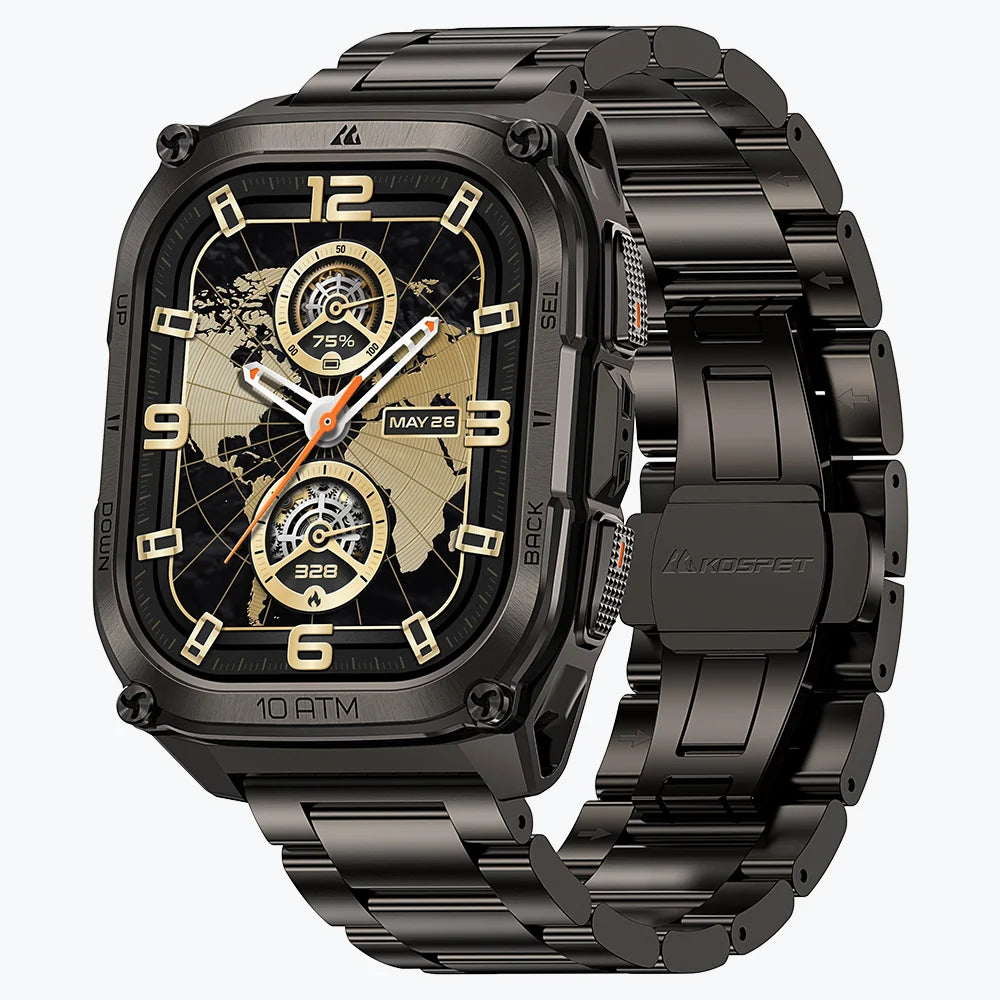
- You want one watch for running and everyday wear: The stainless-steel square design, built-in speaker and microphone, health tracking, and daily smart functions make it easier to use beyond training.
The MAGIC P10 is the more practical choice for short road runs, beginner fitness plans, gym sessions, and daily activity tracking.
It does not offer the TANK T4’s offline maps, route-file navigation, local music capacity, or 10 ATM water resistance. Choose the P10 when everyday usability matters more than advanced outdoor navigation.
Which One Fits Your Running?
Choose the KOSPET TANK T4 when your main concerns are:
- Outdoor GPS performance
- Unfamiliar routes
- Offline navigation
- Local music
- Longer GPS battery life
- Rugged protection
Choose the KOSPET MAGIC P10 when your main concerns are:
- Beginner training guidance
- City and road running
- A larger everyday display
- Wet-screen operation
- Fitness and daily smart functions
- A lower-cost entry into GPS tracking
Do not select the TANK T4 only because it has more outdoor functions. Those features add value when you use them.
Do not select the MAGIC P10 only because it looks more suitable for everyday wear. Confirm that its training tools address the way you exercise.
The correct product is the one that removes your most frequent frustration.
FAQs
Is a phone enough for tracking beginner runs?
A phone is enough for runners who only review time, distance, average pace, and route after a workout. A GPS running watch offers more value when you need information during the run or want to leave the phone at home.
What features should a beginner look for in a running watch?
The most useful beginner features are built-in GPS, a readable workout screen, run-walk interval alerts, basic heart-rate tracking, reliable controls, comfortable fit, and practical battery life.
Can a running watch track a run without a phone?
Yes, a watch with built-in GPS can record distance, pace, and route without using a phone. Calls, live tracking, online music, and some safety functions may still require a connected phone or cellular service.
Is heart-rate tracking useful for beginner runners?
Heart-rate data helps beginners compare effort across similar runs and avoid training too hard. Wrist-based readings should be treated as a trend rather than a medical measurement, especially during fast intervals or when the watch fits poorly.